
Most Americans Are Living on the Edge of Financial Survival in 2026
When 63% of Americans can't make it to their next paycheck without running short, it's worth asking what's really going on. A new CouponFollow survey of over 1,000 people dug into the everyday financial pressures households are facing right now, from relying on Buy Now, Pay Later for groceries to skipping trips to the doctor. The results show a country that's working hard but struggling to keep up.
Key Takeaways
- 63% of Americans ran out of money before payday at least once this year.
- 1 in 2 Americans (50%) describe themselves as financially stressed.
- 2 in 5 Americans (41%) used Buy Now, Pay Later in the past 12 months.
- 39% of Americans skipped or delayed medical care because of cost.
- 73% of Americans made at least one financial trade-off in the past year.
- 49% of Americans say their financial situation is not sustainable long-term.
How Far Does Your Paycheck Actually Get You?
The gap between paydays is where a lot of Americans feel the most pressure. For some, it's a manageable stretch. For others, especially younger workers and lower-income households, the money runs out long before the next check hits.
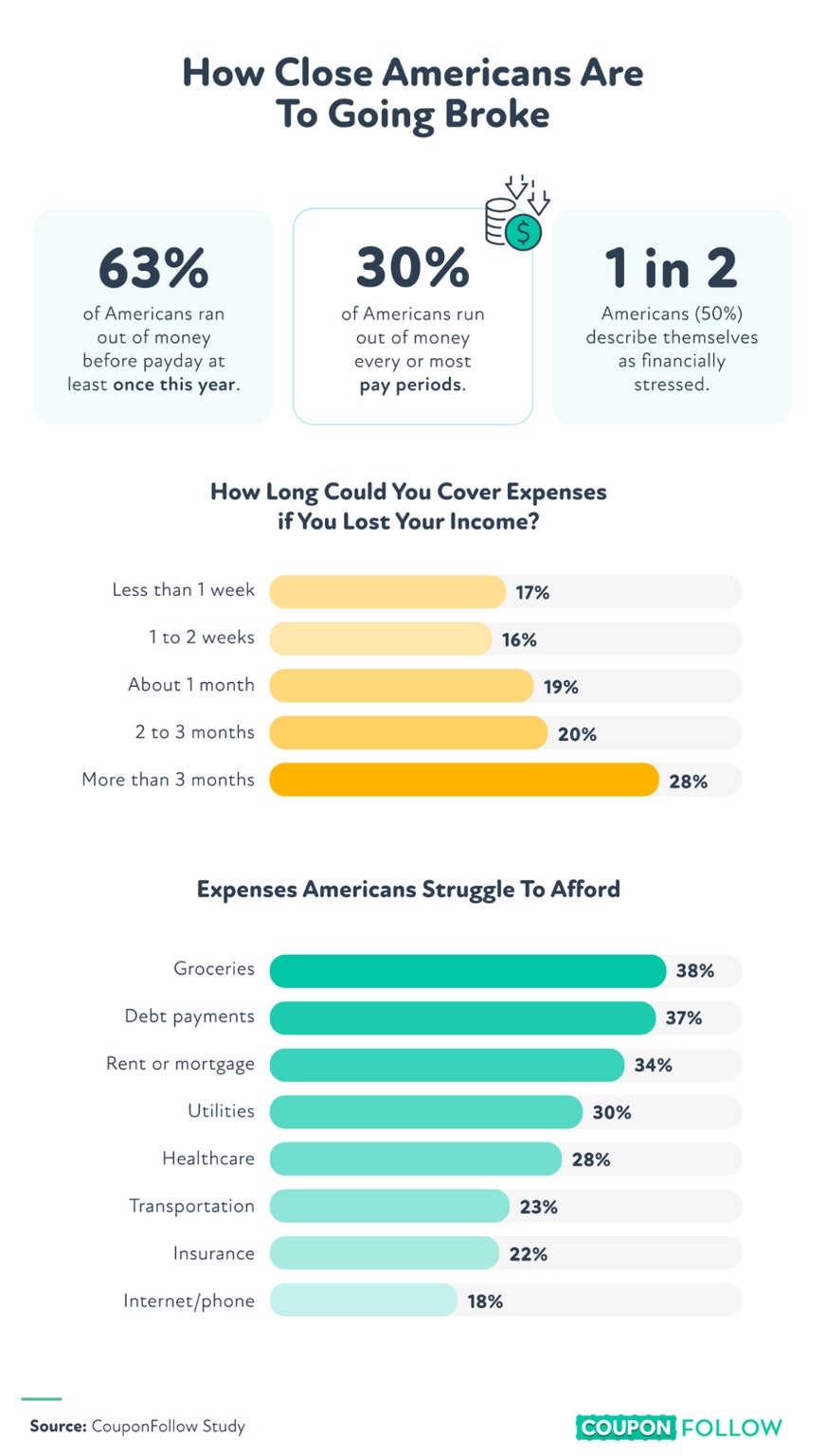
- Nearly 2 in 3 Americans (63%) ran out of money before payday at least once this year.
- 30% of Americans run out of money every or most pay periods.
- 1 in 2 Americans describe themselves as financially stressed. They most often struggle to afford groceries (38%) and debt payments (37%).
If Americans Lost Their Income, How Long Could They Last?
- 38% of women would run out of money in under 2 weeks, compared with 27% of men.
- 21% of women and 12% of men couldn't last a single week without income.
- Baby boomers are dramatically better off: 49% could last 3+ months, vs. only 24–28% for younger generations. Only 16% would be broke in under 2 weeks.
- Gen Z is the most vulnerable: 37% would be broke in under 2 weeks, and 20% couldn't last even 1 week.
- 29% of those earning under $25K couldn't last a week, and 45% would be out within 2 weeks. Compare that to only 3% of $100K+ earners who couldn't last a week.
- $100K+ earners are 3x more likely to have 3+ months of cushion (48%) than under-$25K earners (17%).
Using Credit To Cover Everyday Costs
When budgets get tight, people find ways to make it work. Coupons are back in a big way, and Buy Now, Pay Later has gone from a convenience to a lifeline for many households. But there's a fine line between using these tools strategically and becoming dependent on them.
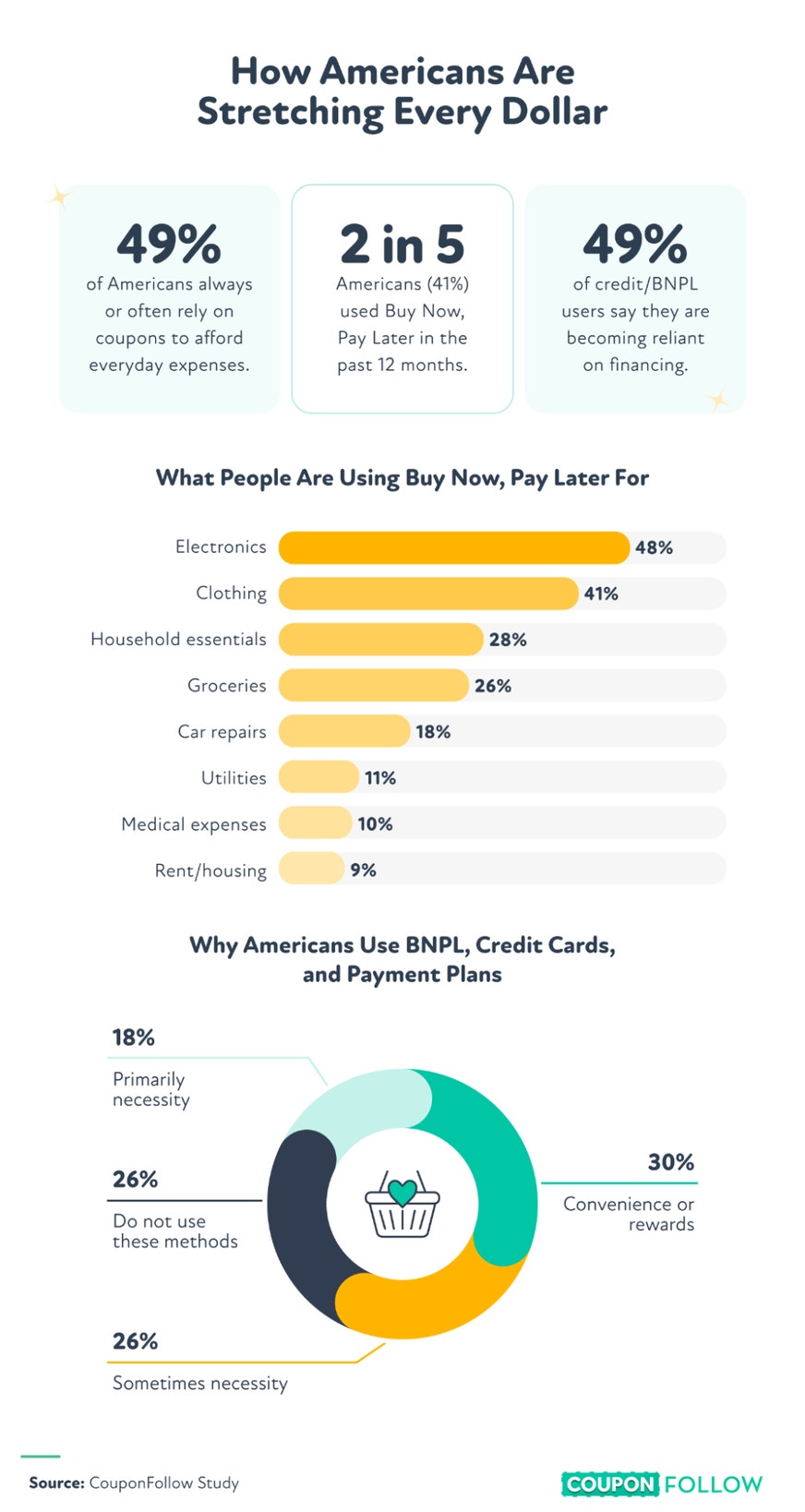
Alt text: Infographic showing many Americans rely on coupons and Buy Now, Pay Later, mainly for electronics and clothing purchases.
- 49% of Americans always or often rely on coupons to afford everyday expenses.
- Women (54%) are more likely than men (45%) to use coupons frequently.
- 59% of those earning under $25K frequently use coupons, compared to 36% of those earning $100K+.
Buy Now, Pay Later Trends
- 2 in 5 Americans (41%) used Buy Now, Pay Later in the past 12 months. Those earning $25K to $49K have the highest BNPL usage rate at 48%.
- 49% of credit/BNPL users say they are becoming reliant on financing.
- Among BNPL users, electronics (48%), clothing (41%), and household essentials (28%) are the most common purchases.
- About 1 in 3 BNPL users (35%) have used it for at least one essential expense (groceries, gas, rent, or utilities).
- 18% of BNPL users primarily use them out of necessity to afford essentials.
- Millennials (49%) and Gen Z (46%) are the most likely to use BNPL, compared to 34% of Gen X and 17% of baby boomers.
- Millennials report the highest credit reliance at 53%, followed by Gen X at 51%.
What Are People Giving Up To Stay Afloat?
Even with all the budgeting and deal-hunting, a lot of Americans are still having to make tough calls about what to cut. For some, that means fewer nights out. For others, it means skipping a doctor's appointment or dipping into retirement savings.
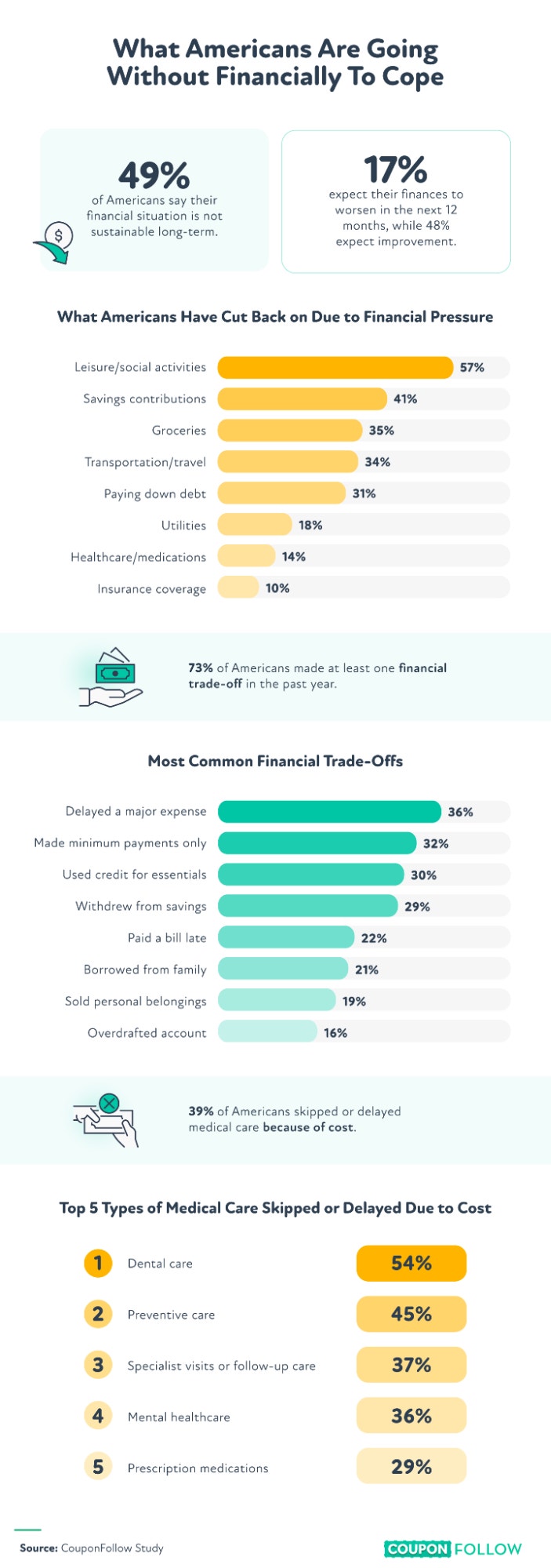
- 49% of Americans say their financial situation is not sustainable long-term.
- 60% of Gen Z say their finances are not sustainable, the highest of any generation.
- 48% expect their finances to improve in the next 12 months, while 17% expect them to worsen.
- Baby boomers are the most pessimistic: 26% expect their situation to worsen, compared to just 10% of Gen Z.
- More than half of Americans (57%) have cut back on leisure and social activities due to financial pressure. Another 41% reduced savings contributions, and 31% cut back on paying down debt.
-
73% of Americans made at least one financial trade-off in the past year.
- 32% of Americans made only minimum payments on bills.
- 29% withdrew money from savings or retirement accounts to cover expenses.
The Impact on Health
- 39% of Americans skipped or delayed medical care because of cost (22% multiple times, 17% once).
- Among those who skipped care, dental care (54%) was the most commonly delayed, followed by preventive care (45%) and specialist visits (37%).
- Millennials (42%) are most likely to skip medical care, compared to 28% of baby boomers.
What Can You Do About It?
Most Americans aren't struggling because of poor choices. The gap between earnings and everyday costs has simply become razor-thin. But small, consistent habits add up, like using coupon codes and browser extensions at checkout, comparing prices before buying, and building even a modest savings buffer. Knowing when to lean on financing tools and when to wait can also help keep spending from spiraling.
Methodology
We surveyed 1,001 Americans to understand how households are managing everyday financial pressures in 2026. The survey examined paycheck-to-paycheck living, expense affordability, coupon and Buy Now, Pay Later reliance, financial trade-offs, medical care delays, and long-term financial outlook.
The average age of respondents was 42. The gender breakdown was 54% women, 44% men, and 2% nonbinary or not listed. Millennials made up the largest share of respondents (49%), followed by Gen X (25%), Gen Z (14%), and baby boomers (12%). Income levels ranged from under $25K (28%), $25K–$49K (23%), $50K–$74K (20%), $75K–$99K (13%), $100K–$149K (11%), and $150K or more (5%). The survey was conducted online in March 2026.
About CouponFollow
CouponFollow is a coupon code platform that helps millions of shoppers save money every month. Through our website and free browser extension, Cently, we find, verify, and automatically apply the best promo codes at checkout across thousands of online retailers. If this study hit close to home, start browsing deals on CouponFollow and see how much you could be saving.
Fair Use Statement
We encourage you to share this study's findings for noncommercial purposes. All we ask is that you link back to this page so readers can see the full results and methodology.
About The Author

Senior Trends Analyst
<p> As an e-commerce analyst at CouponFollow, Clay enjoys spending his time collaborating with brands to make helpful content for consumers and finding great deals to share on CouponFollow. As a recent college graduate, his primary focus is creating resources for consumers, especially students, to save money through online shopping and everyday life. </p>